Two Dubai study abroad firms are neck-and-neck for AI visibility. One of them is winning smarter.
When we ran the Gulf Study Abroad AI Visibility Index — 32 UAE consultancies tested across 30 buyer-intent prompts and 4 AI engines, 102 checks per firm — the top of the table looked like a photo finish.
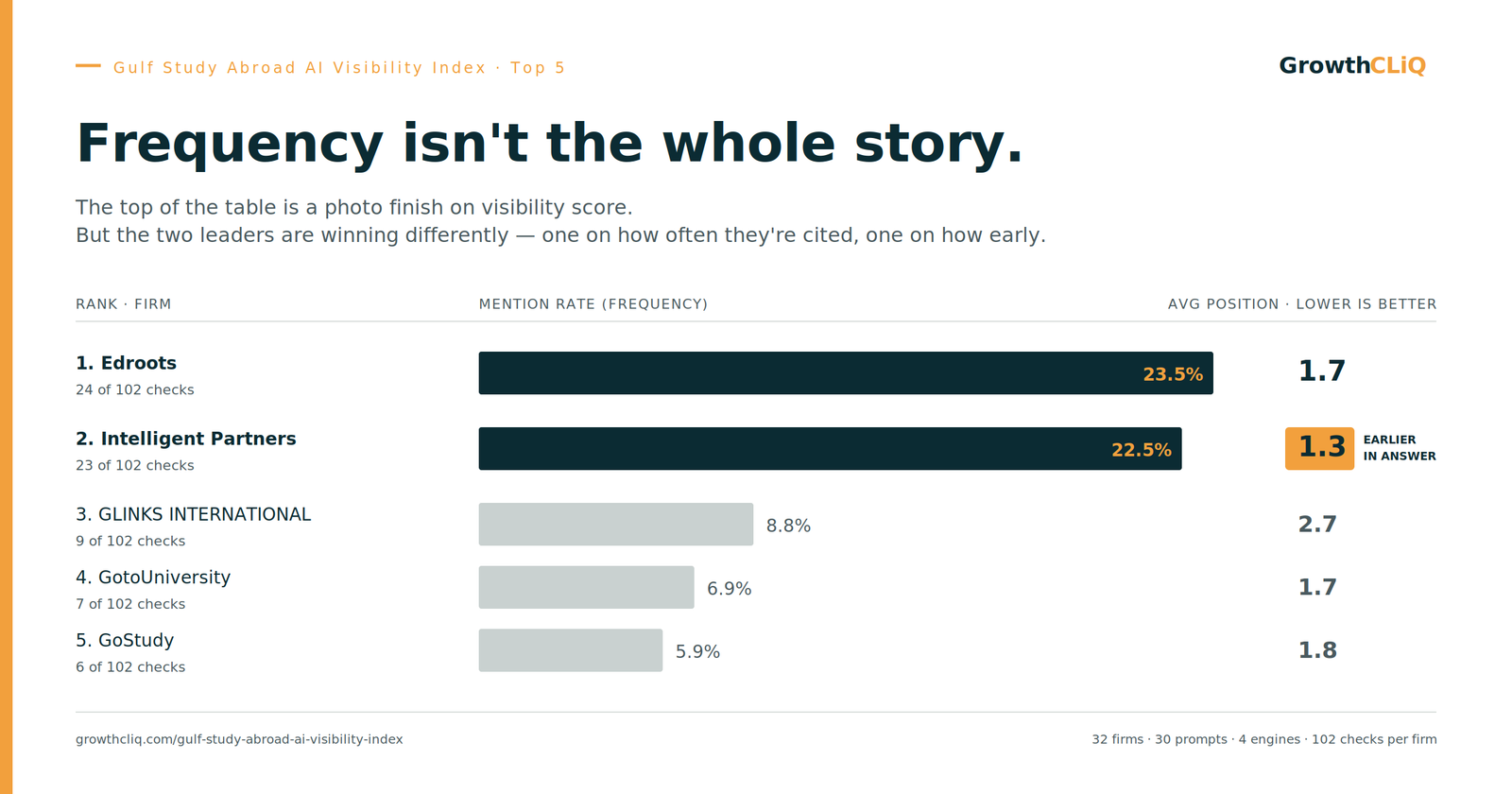
Edroots: 45.6. Intelligent Partners: 45.4.
Two tenths of a point separate them. In a category where more than half the tracked firms scored zero — never cited once in 102 attempts — being in that top-two conversation is already the game. But look one layer down and the two firms are winning very differently.
The frequency-vs-position split
| Edroots (Rank 1) | Intelligent Partners (Rank 2) | |
|---|---|---|
| Visibility Score | 45.6 | 45.4 |
| Mention rate | 23.5% | 22.5% |
| Times mentioned | 24 of 102 | 23 of 102 |
| Avg mention position | 1.7 | 1.3 |
Edroots is mentioned slightly more often. Intelligent Partners is mentioned earlier in the answer. Neither is a rounding error.
When ChatGPT, Claude, Perplexity, or Google AI Overviews return a shortlist, order matters. Being name-checked at position 1 or 2 is qualitatively different from being name-checked at position 4 or 5 — a parent reading an AI answer on their phone forms an impression from the first two names before they’ve finished the paragraph. Intelligent Partners is inheriting that primacy more often than Edroots is.
That’s a design choice, not luck.
What the pattern is telling us
A firm cited more often but later in the answer usually has one of two profiles:
- Broad topical footprint, moderate authority signal. The engines find them relevant to many queries but not the most authoritative on any single one. They surface — but as “also worth considering” rather than “the firm to talk to.”
- Strong entity recognition, weaker distinctiveness. The engines know the firm exists and know what category it’s in, but nothing about the entity is telling them this is the one to name first.
A firm cited less often but earlier usually has the inverse:
- Narrower topical footprint, higher authority per hit. When they show up, they show up prominently — because whatever signals the engines are reading (structured schema, tightly-scoped service pages, consistent entity graph, third-party citations that match the topic) all point in the same direction.
- Sharper positioning. Their site, their LinkedIn, their directory listings all describe the same thing in the same words. Ambiguity is the enemy of position-1 citation, and this firm has less of it.
Without access to either firm’s back-end, I can’t tell you which of these mechanics is doing the work at Intelligent Partners specifically. What I can tell you is that the gap between them is not random and it is not about marketing spend. It’s about the quality of the entity signal each firm is emitting.
Why this matters for everyone else in the Index
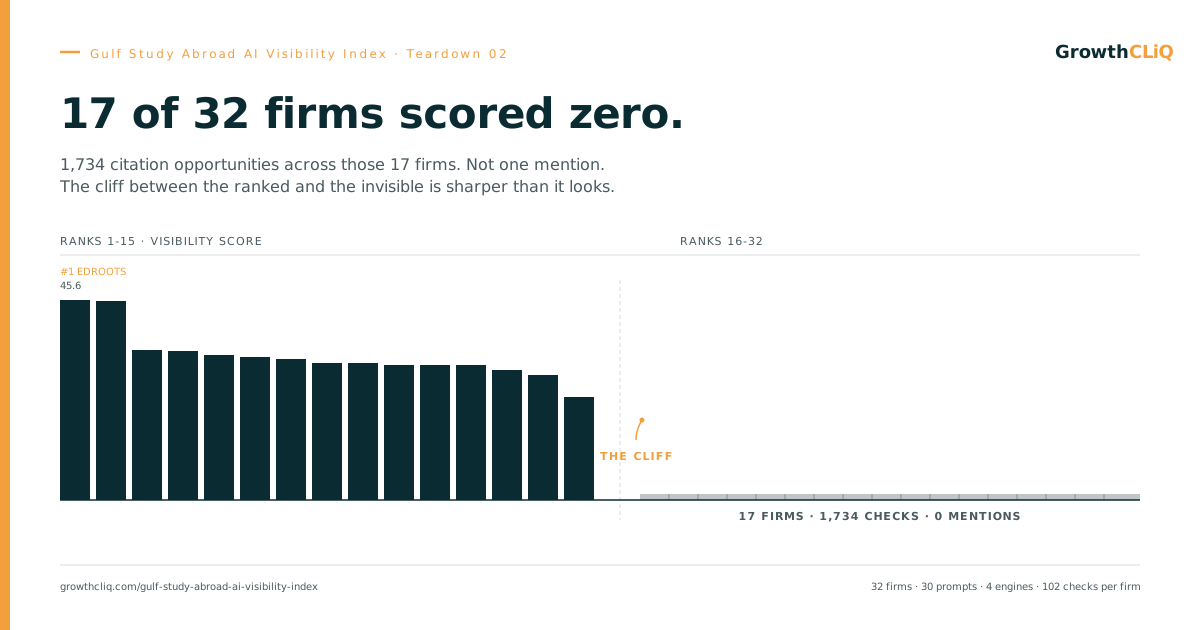
The more interesting finding isn’t at ranks 1 and 2 — it’s the shape of the entire table.
- The gap from rank 2 to rank 3 is 11.3 points. That’s larger than the gap between rank 3 and rank 15.
- Ranks 3 through 15 are clustered between 23 and 34 — a tight middle where small technical changes move a firm meaningfully.
- Ranks 16 through 32 all scored 0.0. Seventeen firms, 1,734 total checks, zero citations. Not “low visibility” — literal invisibility.
If you’re in the middle band, the lesson from the top isn’t “outspend Edroots.” It’s choose whether you’re going to compete on frequency or on position, and build your entity and content signals to match. Trying to do both at once with a small team is how firms end up in the middle band.
If you’re in the zero band, none of the above applies to you yet. Frequency and position debates are premature when the engines don’t know you exist. That’s a different, more fixable problem — and one we’ll write about next.
The takeaway in one line
AI visibility isn’t one number. It’s frequency × position, and the two are separately optimisable. The firms at the top of the Index are treating them as separate levers. Most of the rest of the market is treating them as the same thing — or not treating them at all.
Where does your firm stand?
Want to know where your firm actually stands across all 30 prompts and 4 engines, benchmarked against 5 competitors you name? That’s what the AI Visibility Diagnostic does. $800, 7 days, no proposal.