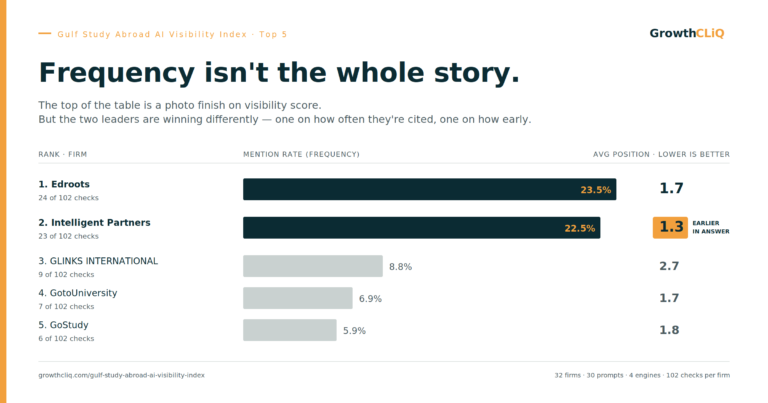
Seventeen UAE study abroad firms scored zero in the Index. Here’s what they have in common
Seventeen of the 32 UAE study abroad consultancies we tracked scored zero.
Not “low.” Not “struggling.” Zero. Across 102 checks per firm — 30 buyer-intent prompts run through ChatGPT, Claude, Perplexity, and Google AI Overviews — 1,734 total citation opportunities for those 17 firms produced not a single mention. Not one. The engines, asked repeatedly which UAE study abroad consultancy to recommend, named someone else every time. If your firm is in that group, you already suspect it. You’ve asked ChatGPT about your own category and watched it name four other firms and skip yours. You’ve wondered whether it’s a brand problem, a budget problem, or something else. And it’s fixable.What “zero” actually means
Before getting to the fix, worth being precise about the measurement. The Index uses 30 prompts a UAE parent or student might realistically type — things like “best study abroad consultants in Dubai for Canada”, “affordable overseas education agents in UAE for UK masters”, “which consultancy helps with Ireland PR pathway from Dubai.” Each prompt is run through four engines. Each engine returns an answer that names between zero and ten firms. “Zero” means your firm was not in any of those answers. Not misspelled, not demoted to fifth position, not cited in a different form. Absent. That’s not a distribution-noise story. If the engines were drawing names at random from a hat, every firm in the Index would show up a handful of times by chance alone. Zero across 102 checks is a signal: the engines don’t think of you as part of the category at all.The five things zero-scoring firms almost always share
After auditing a reasonable sample of this group — not just UAE study abroad but similar zero-visibility firms across other verticals — the pattern is consistent. Five things usually line up at the same time: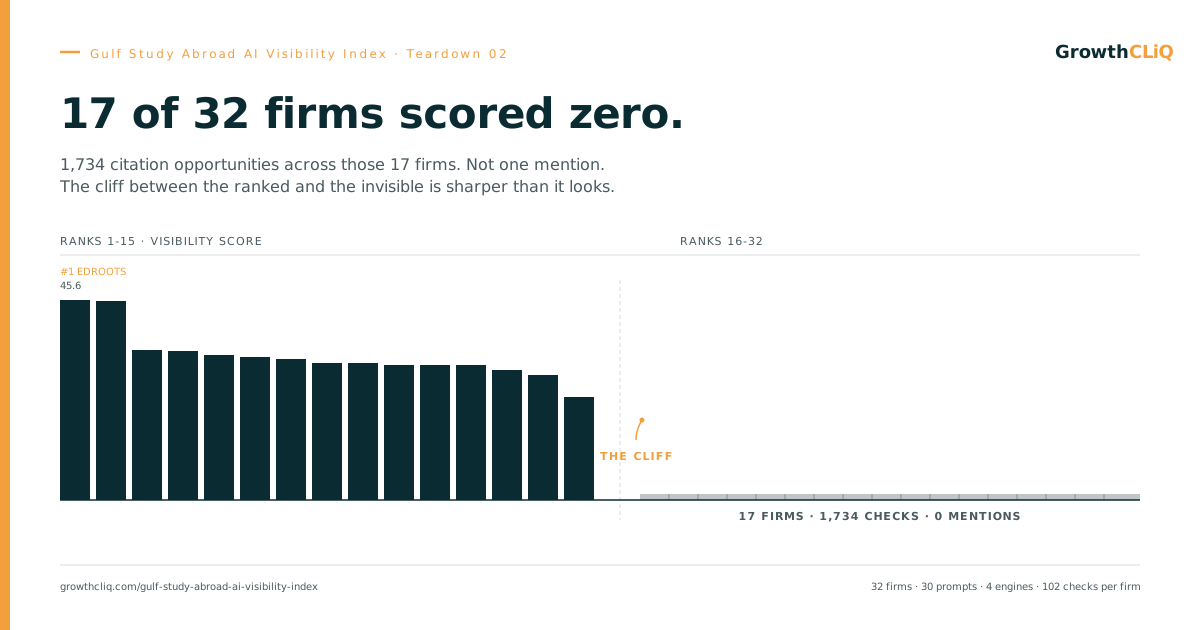
- Your site’s content lives in images and PDFs, not HTML text. Beautifully designed home pages where the hero section is an image of text, the service breakdown is a PDF download, and the FAQ is a lightbox modal. AI engines read HTML. Everything else is a dead zone to them. If a crawler has to be an image-recognition system to understand your value proposition, it won’t bother.
- Your business name appears three or more different ways across your own web presence. The site says “Acme Overseas Education.” The LinkedIn page says “Acme Overseas Education LLC.” Google Business Profile has “Acme Education Dubai.” The Instagram handle is @AcmeEduDxb. To a human, these are obviously the same firm. To an AI engine building an entity graph, they look like four different firms, each with weak signal. None of them accumulates enough authority to be cited.
- There is no JSON-LD structured data on your site. No Organization schema. No LocalBusiness. No FAQPage. No Person entity for the founder. The engines are left to infer everything from the raw HTML, which they can do but do worse than when you tell them explicitly what you are.
- Your robots.txt file is silent on AI crawlers. GPTBot, ClaudeBot, PerplexityBot, OAI-SearchBot, Google-Extended — none of them are mentioned. On many WordPress sites, the default robots.txt is actively blocking some of them. On many others, the crawlers are allowed by default but you have no way of knowing which. If you’ve never looked at your robots.txt, you probably don’t know what you’re telling the engines.
- Your home page doesn’t answer, in HTML text, in the first visible 200 words: who you are, where you are, who you help, with what. The engines are looking for a self-contained statement that would let them cite you confidently. If your home page opens with a hero image, a tagline, and a “Watch Our Video” button, there is nothing for them to lift.
Most zero-scoring firms have all five of these at once. Fixing any one of them in isolation moves the needle a little. Fixing all five moves it a lot.
Why this matters more than the top of the table
The last teardown was about optimising frequency vs position when you’re already in the game. This one is about joining the game at all.
If you’re in the middle band of the Index — ranks 3 through 15 — you have real work to do, but you have a baseline to build from. The engines know you exist. You need them to think of you first.
If you’re in the zero band, none of that applies yet. You need the engines to know you exist. That’s a smaller, more specific technical problem — and almost always a cheaper one to solve than the firms in the middle band realise.
The uncomfortable part
Most of the firms in the zero band aren’t zero because they’re bad at what they do. Several of them have been operating in the UAE for a decade or more. They have real offices, real students, real outcomes. They are good consultancies — just invisible ones.
That gap, between the quality of what you do and the quality of what the engines can see, is the cheapest gap to close in marketing right now. SEO took a decade to become expensive. Paid media was never cheap. AI search visibility is still the thing where a focused month of work moves a firm from zero to the middle band.
The engines are not going to stay this forgiving.
Want to know which of the five patterns applies to your firm — and in what order to fix them? That’s what the AI Visibility Diagnostic does. $800, 7 days, no proposal.